
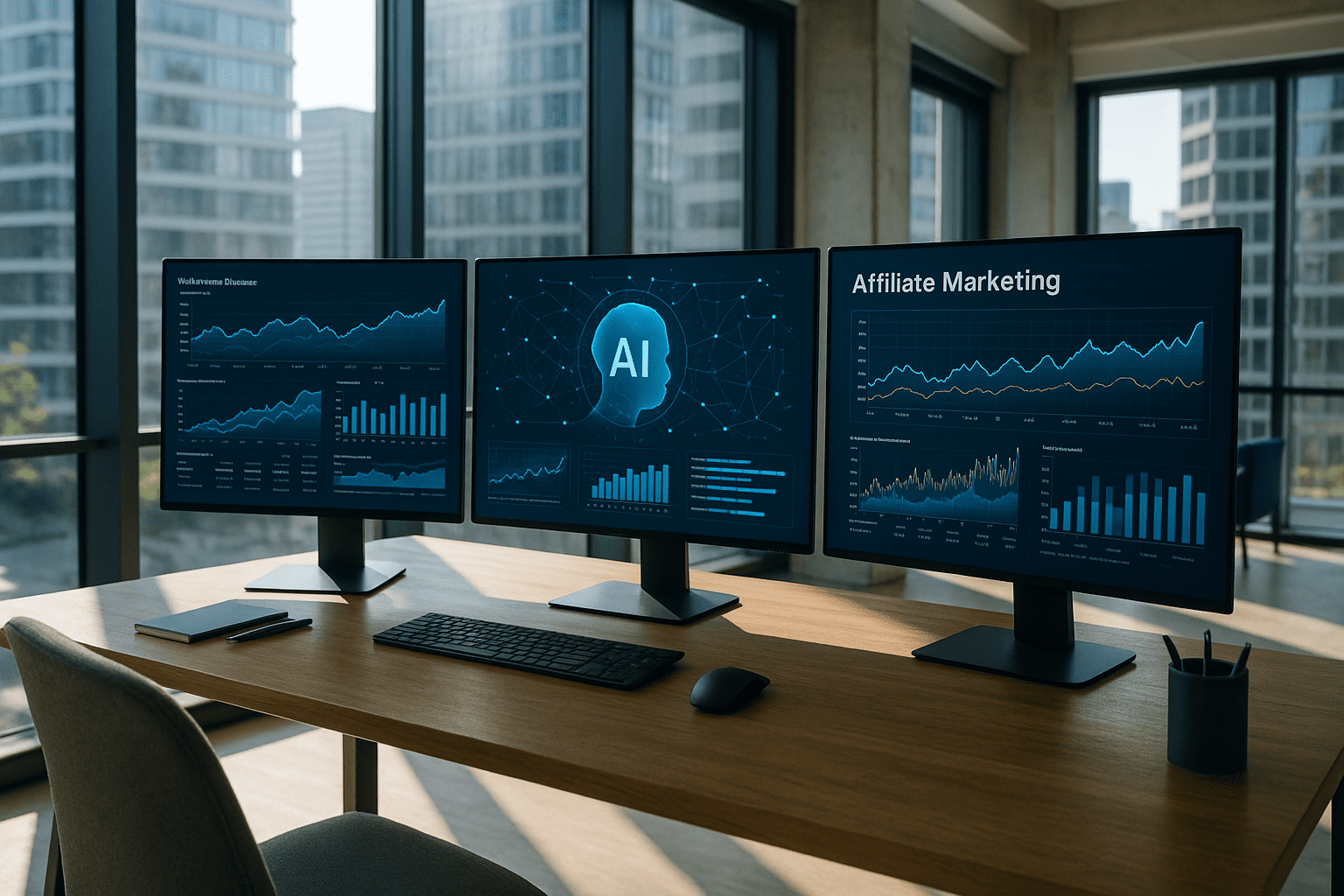
Affiliate marketing has long been a cornerstone of online business strategies, linking product creators, publishers, and consumers through a network of rewards for performance. As the amount of available data grows and consumer behavior becomes more complex, marketers face a tougher challenge: cutting through the noise to engage the right audience with relevant offers.
This is where artificial intelligence steps in, gradually taking a more central role in steering affiliate campaigns. It is not about flashy robots or sci-fi visions but practical tools and systems that learn from data patterns and automate decisions that once took hours, if not days, of human effort.
The subtle hand of data in shaping campaigns
One of the most significant ways AI changes affiliate marketing lies in data analysis. Affiliates and networks receive a constant flood of information, from clicks and conversions to browsing habits and geographic details. AI systems sift through this noise to detect patterns that are not immediately obvious.
Instead of relying mainly on intuition or standard segmentation, marketers can deploy AI-driven analytics to identify emerging trends, seasonal shifts, and consumer preferences almost in real time. This means campaigns can be tailored with greater precision, honing in on prospects more likely to convert.
Platforms that embed AI can track a visitor’s journey across multiple sites and devices, combining disparate data points into a more comprehensive picture. This wider lens allows marketers to optimize their message timing, content placement, and even the type of offer presented.
For example, an affiliate network may use AI to recognize that certain product categories perform better in particular time windows or that users from a specific region respond favorably to a campaign variant with localized elements.
Automation beyond scheduling
Affiliate marketing has benefited for years from programmatic tools that automate tasks like scheduling posts or tracking affiliate links. AI pushes this automation further by introducing machine learning models that adapt continuously. It is not just about setting rules in advance but about systems that observe results and adjust campaigns in flight.
Dynamic budget allocation is a case in point. Rather than distributing advertising spend equally or via static rules, AI algorithms can shift resources toward affiliates or channels showing better return on investment at any given moment. This real-time rebalancing helps maximize impact without constant human intervention.
Similarly, creative elements such as ad copy or banner design can be tested and optimized automatically. AI can generate variants or recommend changes based on engagement metrics. Over time, this iterative process leads to creative assets that resonate better with audiences targeted in different contexts.
Personalization at scale without the manual overload
Customers today expect marketing that feels personal, even if they encounter it across broad platforms or multiple campaigns. Meeting that expectation manually would be overwhelming, but AI makes it feasible.
By analyzing user profiles and behavior, AI enables affiliates to deliver content and product recommendations that align closely with individual preferences. This customization extends to email marketing, where AI can determine the best time and message format for each recipient.
However, there are challenges here. Overpersonalization risks creeping into privacy concerns or turning marketing messages into intrusive experiences. Sophisticated AI tools must therefore balance personalization with respect for data boundaries and user consent, a balance that marketers are learning to manage more carefully.
Understanding AI’s limits amid hype and complexity
Despite the benefits, AI is not a magic wand that guarantees success. Its usefulness depends heavily on the quality of data fed into the system and how well it is integrated into workflows. Poor data hygiene or fragmented affiliate ecosystems can hinder AI’s ability to learn and act effectively.
Moreover, interpreting AI recommendations requires a human judgment layer. Machines can detect correlations between actions and outcomes, but they do not fully understand context, emerging cultural shifts, or competitor moves in nuanced ways. Marketers who treat AI as an assistant rather than a replacement tend to get closer to practical gains.
Many in the affiliate industry still experiment with how best to incorporate AI-driven tools. Testing and incremental implementation remain common. While some platforms offer all-in-one AI features, others provide plug-ins or API-driven options that allow marketers to combine AI with existing proprietary systems.
Regulation and ethical use of AI also come into focus. Transparency about how AI models work and how data is used becomes an important part of building trust among affiliate marketers, publishers, and consumers.
Looking ahead, AI will likely deepen its integration with affiliate marketing, but the evolution will feel more like a steady maturation of existing practices than a sudden revolution. The partnerships between human insight and machine efficiency remain at the core.
For those working in this world, the lesson is not to chase AI as a shiny new tool but to understand where it genuinely supports better decisions, enhances user experience, and respects the boundaries of real world data use. In this way, affiliate marketing’s age-old challenge – turning connection and referral into value – finds new pathways shaped by data, automation, and thoughtful application of artificial intelligence.
For more insights on affiliate marketing trends and AI, exploring how industry leaders approach AI-powered campaigns provides concrete examples. Industry reports from groups like Interactive Advertising Bureau offer ongoing analysis of data trends shaping marketing technology. Meanwhile, guides from Marketing AI Institute help decode the evolving AI landscape for affiliate marketers navigating these tools.
The landscape is not static. Affiliate marketing remains a complex ecosystem where understanding the limits and possibilities of AI proves as important as the technology itself.
Sources and Helpful Links
- Affiliate Marketer Training: AI in Affiliate Marketing, practical insights and case studies
- Interactive Advertising Bureau, industry standards and research on digital advertising
- Marketing AI Institute, resources on applying AI in marketing contexts